

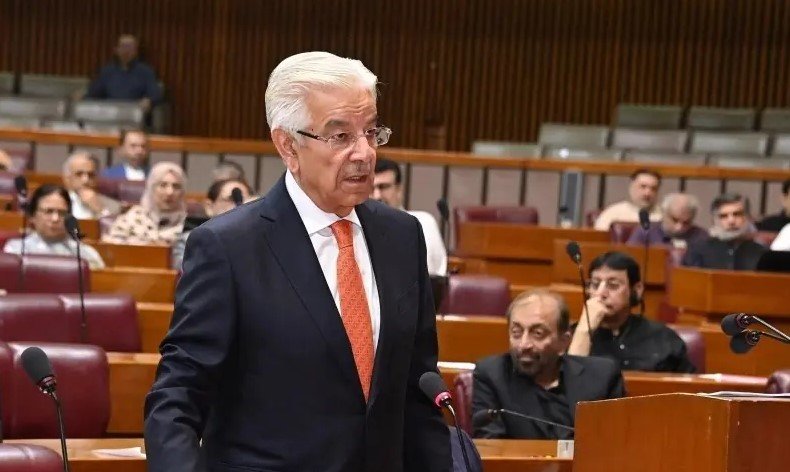
ISLAMABAD (MNN); A heated debate erupted in the National Assembly on Wednesday after Defence Minister Khawaja Muhammad Asif faced criticism from coalition partner PPP over his remarks regarding the people of Rawalakot in Azad Jammu and Kashmir (AJK).
The controversy began after Khawaja Asif, during a television interview, stated that Rawalakot was “not Kashmir” and that he did not consider its residents to be Kashmiris. The remarks came amid ongoing protests in the area led by the Joint Awami Action Committee (JAAC).
Following public criticism, the minister clarified on social media that Kashmiri identity was defined by decades of sacrifices and struggle for the Kashmir cause rather than by place of birth or official documents.
Speaking on the floor of the National Assembly, PPP leader and former prime minister Raja Pervaiz Ashraf strongly objected to the comments, describing them as an inappropriate and sweeping statement, particularly coming from a senior federal minister.
Ashraf said the remarks had hurt the sentiments of many people and stressed that Azad Kashmir remained a highly sensitive region requiring careful handling. He emphasized that efforts should focus on easing tensions and addressing the concerns of Kashmiris rather than aggravating the situation.
Calling the statement detrimental to Pakistan’s Kashmir narrative, Ashraf offered an apology to the people of Rawalakot on behalf of the defence minister and urged all stakeholders to act responsibly.
Responding to the criticism, Khawaja Asif referred to his clarification, maintaining that Kashmiri identity could not be determined merely through a birth certificate and that his comments had been misunderstood.
The debate intensified when PPP Chairman Bilawal Bhutto Zardari addressed the House, expressing concern that some ministers were creating difficulties for Prime Minister Shehbaz Sharif despite his efforts to build consensus among coalition partners and the opposition.
Bilawal praised the prime minister’s work ethic, political engagement and attempts to steer the country through challenging circumstances. However, he argued that certain ministers were undermining those efforts by making controversial statements.
He questioned how a minister could remain in the federal cabinet after insisting that the people of Rawalakot were not Kashmiris and refusing to apologise. Bilawal said such remarks were equivalent to adding fuel to an already volatile situation in Azad Kashmir.
The PPP chairman noted that both the federal government and political parties had attempted to address AJK’s issues through political means. He stressed the need to resolve the dispute through dialogue rather than confrontation.
Bilawal also welcomed efforts by Maulana Fazlur Rehman to help mediate and reduce tensions in AJK. He suggested that all political stakeholders should provide space for constructive engagement between the federal government, the AJK administration and protest groups.
He further argued that Prime Minister Shehbaz Sharif should have full authority over his cabinet and that conflicting public positions by ministers only complicated governance and weakened the government’s policy direction.
Meanwhile, Prime Minister’s Adviser on Political Affairs Rana Sanaullah also addressed the House and linked the recent unrest in AJK to efforts aimed at influencing the upcoming elections scheduled for July.
He argued that decisions regarding the status of 12 refugee seats in the AJK Legislative Assembly could only be made through constitutional and parliamentary processes, not through street protests. According to him, both an all-parties conference and the AJK Supreme Court had previously supported this position.
Sanaullah said that, apart from Rawalakot, no major demonstrations were taking place elsewhere in AJK. He claimed that the JAAC currently had eight demands, including the removal of a declaration in nomination papers stating that Kashmir would join Pakistan after the success of its freedom movement.
The adviser criticised some of the group’s rhetoric and social media activity, questioning whether certain statements were compatible with the Kashmir freedom movement. He urged the JAAC to withdraw its protest plans and demands before engaging in further talks with the federal and AJK governments.
Separately, Khawaja Asif turned his attention to the opposition, urging its members to reflect on their own political record before criticising the government. He called on opposition parties to sign a new Charter of Democracy and learn from past political confrontations.
Recalling the political tensions of the 1990s, Asif said both the PPP and PML-N had eventually recognised the need for democratic cooperation and mutual respect. He credited former prime ministers Benazir Bhutto and Nawaz Sharif with establishing a framework for democratic engagement through the Charter of Democracy.
The defence minister also criticised the former PTI government, accusing it of damaging parliamentary traditions and democratic norms. He referred to the passage of multiple pieces of legislation in a short period before the dissolution of the National Assembly and said Pakistan’s political system still required further constitutional reforms.
Asif acknowledged that past governments, including those led by the PPP and PML-N, had made mistakes but argued that both parties had learned from experience and pursued institutional reforms.
During the same sitting, the National Assembly approved supplementary grants worth Rs593.64 billion for the fiscal year 2024-25, along with Rs482 billion in additional expenditures for the outgoing financial year.