

Islamabad :MNN
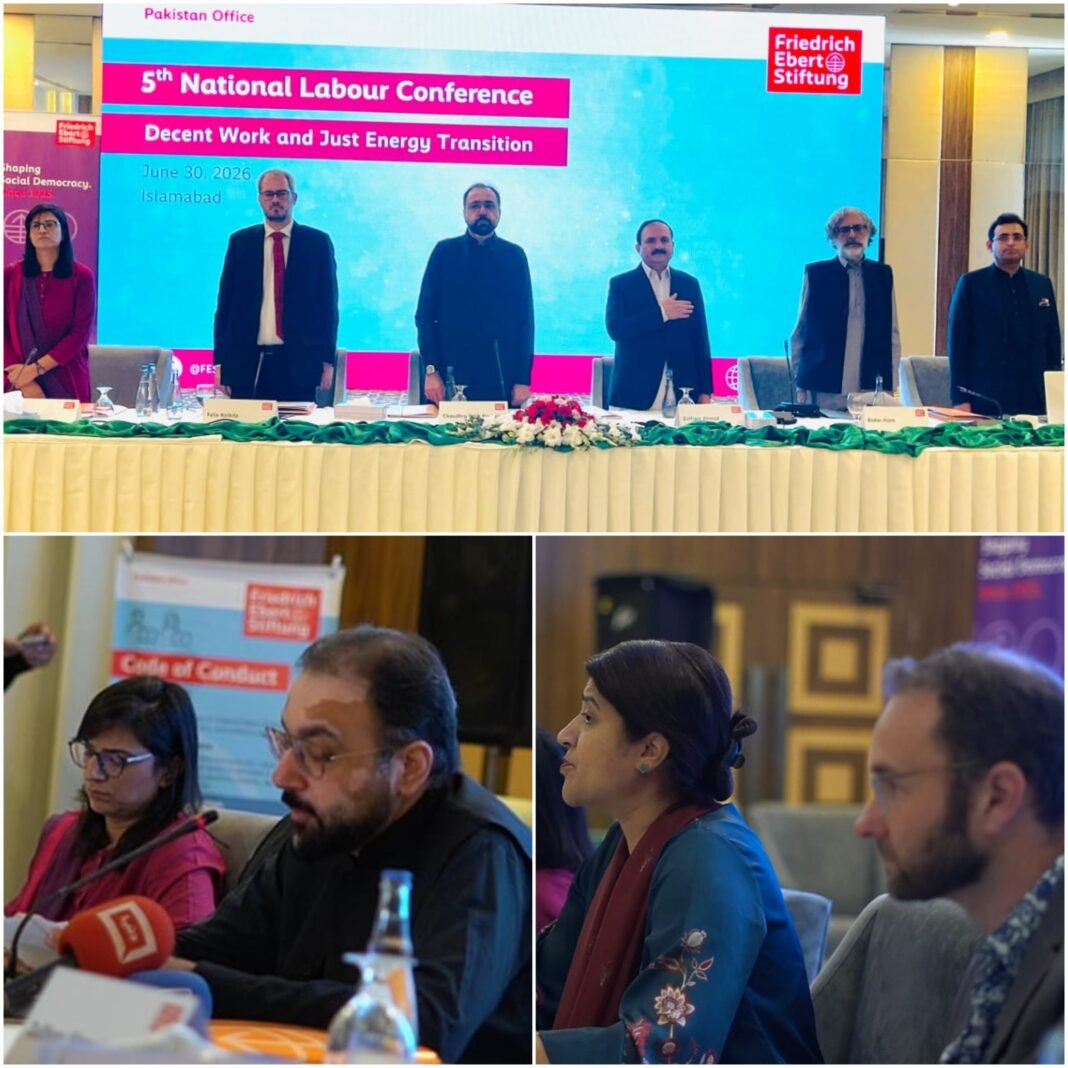
As Pakistan accelerates its transition towards a low-carbon and climate-resilient economy, labour leaders, policymakers, and experts are urging that workers’ rights and decent jobs remain at the heart of the process. The call was made during the 5th National Labour Conference held in Islamabad.
As Pakistan moves towards a cleaner and more sustainable energy future, experts and policymakers have stressed that the transition must be fair, inclusive, and centered on protecting workers’ livelihoods.
The call came during the 5th National Labour Conference, organized by the Friedrich-Ebert-Stiftung (FES) Pakistan in Islamabad under the theme “Decent Work and Just Energy Transition.”
Addressing the conference, Federal Minister for Overseas Pakistanis and Human Resource Development Chaudhry Salik Hussain said Pakistan’s biggest challenge is not the absence of policies, but the effective implementation of existing ones. He reaffirmed the government’s commitment to promoting decent work, strengthening labour institutions, and ensuring that no worker is left behind during the country’s economic and environmental transformation.
FES Pakistan Country Director Felix Kolbatz highlighted the close link between climate change, informal employment, and growing social inequalities. He emphasized that a just energy transition cannot succeed without meaningful social dialogue, stronger labour protections, gender-responsive policies, and the active participation of trade unions in policymaking.
Speaking on the occasion, FES Pakistan Regional Climate Coordinator Sidra Saeed stressed the need for evidence-based policymaking that aligns climate action with social justice, employment protection, and sustainable development goals.
During the conference, researchers presented studies on climate-adaptive social protection for women working in the informal sector, the role of trade unions in the energy transition, and the impact of power sector reforms on workers and consumers.
Participants called for expanding social protection, strengthening collective bargaining, investing in green jobs and skills development, improving workplace safety, and ensuring workers have a stronger voice in national energy planning.
The conference concluded with a consensus that Pakistan’s journey towards a green economy must go beyond environmental protection by guaranteeing social justice, decent work, and equal economic opportunities. Participants urged the government, employers, and development partners to work together on a comprehensive national strategy that safeguards workers’ rights while promoting sustainable economic growth.
The conference reaffirmed that Pakistan can only achieve its climate and sustainable development goals by placing workers at the center of policy reforms and ensuring that no worker or community is left behind in the transition to a greener future.