

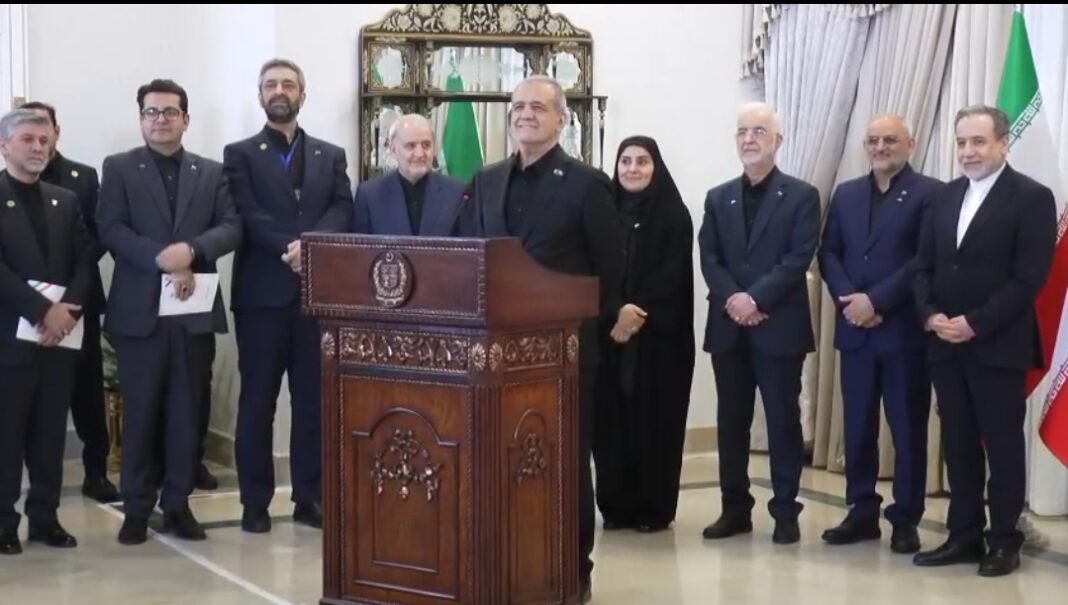
Iranian President Dr. Masoud Pezeshkian arrived in Islamabad on June 23, 2026, for an official state visit — his first overseas trip since the United States and Israel launched strikes on Iran on February 28.
Pakistan’s President Asif Ali Zardari, Prime Minister Shehbaz Sharif, and Deputy Prime Minister Ishaq Dar received the Iranian leader at the Noor Khan Airbase near the capital, where he was given a 21-gun salute and Pakistan Air Force JF-17 jets performed a flypast in his honour. Children dressed in traditional attire presented flowers to the Iranian president, and Prime Minister Sharif personally held an umbrella over his distinguished guest during the welcome ceremony.
The Iranian president arrived aboard a specially named aircraft — “Minab 168” — a tribute to the 168 people killed in an attack on a girls’ school in the Iranian city of Minab on the very first day of the war in February. This was not merely a name for an aircraft. It was Iran’s declaration of grief, announced before the wheels even touched the ground.
The visit came in the wake of high-level US-Iran talks in Bürgenstock, Switzerland, brokered by Pakistan and Qatar, which produced a 60-day roadmap toward a final deal.
This was Pezeshkian’s second visit to Pakistan as president. During his first trip in August 2025 — following the 12-day Iran-Israel war — he visited Lahore and then Islamabad, where twelve bilateral agreements were signed and an ambitious trade target of $10 billion annually was set, up from roughly $3 billion. But this time, Pakistan holds a special place. Iran chose Pakistan as the very first country to visit after the Bürgenstock talks — to personally express gratitude to Pakistan’s political and military leadership and its people for their commitment to the mediation mission.
Since the US-Israel attacks began in February, Prime Minister Sharif and President Pezeshkian had spoken on the phone at least seven times, often in conversations lasting up to an hour.
During the coverage of this historic visit, one thing drew the eye before anything else — the wardrobe. As a journalist, while discussing the visit with colleagues, the Iranian delegation’s dress became a topic of conversation and ultimately a story in its own right.
A delegation of more than seventy people, led by President Pezeshkian, walked into the Serena Hotel in near-perfect uniformity — black suits, open collars, not a single tie in sight. This was not merely an arrival. It was a declaration. This was not coincidence. This was choreography. Look closer, and the details speak louder than any prepared statement. Foreign Minister Abbas Araghchi wore a lapel pin shaped like the map of Iran, edged in gold — sovereignty, outlined and asserted before negotiations even began. Yet Araghchi’s white shirt told a different story from the rest of the delegation entirely.
Who is Araghchi? Abbas Araghchi is a seasoned diplomat who volunteered with the IRGC during the Iran-Iraq War, later earned a doctorate from the University of Kent in the United Kingdom, and served as ambassador to Japan and Finland. His white shirt, standing apart from the sea of black, was carrying its own quiet diplomatic narrative.
According to analysts, it conveyed several messages simultaneously. White is the colour of diplomacy — foreign ministers are the face of negotiations, and white signals openness, peace, and dialogue, perfectly suited to his role. And in wearing it alongside a delegation dressed entirely in black, Iran was delivering a dual message at once: we are in grief, but we are ready to talk.
To understand the black, you must understand Iran from the inside. In Iran, black is not merely a colour — it is mourning, it is Muharram, it is the remembrance of Imam Hussain (AS), kept alive through ritual and grief across generations. But on this occasion, the sorrow was not historical.
It was immediate and present — a Supreme Leader had been martyred, thousands of lives had been lost, and a nation was still counting its wounds. Iran did not arrive dressed for diplomacy. It arrived dressed in memory. This carries a deeper historical root as well: after the Islamic Revolution of 1979, the necktie became a symbol of western cultural allegiance, firmly rejected by the revolutionary generation and subject to an unspoken ban. Iran’s Foreign Ministry later designed collarless shirts for its diplomats, resembling clerical dress. The black shirt and the absent tie thus became a living expression of the spirit of the Islamic Revolution — a tradition Iranian leadership carries to this day.
So the Iranian delegation’s black attire and the foreign minister’s white shirt together composed a complex, multi-layered message. Iran did not dress for diplomacy — it dressed for memory.
The message was unmistakable: we remember, we do not forget, and we do not bend easily. In his white shirt, Araghchi signalled that the door to negotiations remains open — but the terms will be Iran’s. In diplomacy, silent signals carry as much weight as spoken words — and on this visit, black and white together told a story deeper and more enduring than any speech delivered at the podium.
Analysts believe Pakistan is no longer merely facilitating messages. Iran is signalling that Islamabad has become politically invested in the outcome of this process — and that investment carries meaning far beyond a single state visit.
By:Usman Khan , Journalist & Analyst, Vice President National Press Club Islamabad