

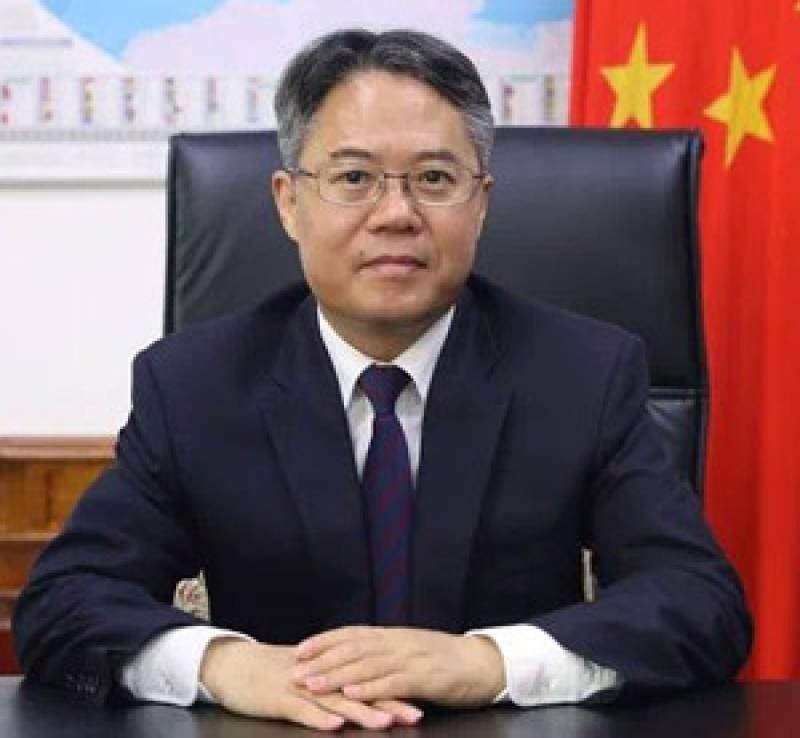
By Ambassadors of China to Pakistan, HE Jiang Zaidong
From October 26th to 29th, the Fifth Plenary Session of the 20th Central Committee of the Communist Party of China (CPC) was successfully held in Beijing. General Secretary Xi Jinping delivered an important address, and the session reviewed and adopted the Resolution of the Central Committee of the Communist Party of China on Certain Major Issues Concerning Persevering with Full and Rigorous Party Self-Governance. Held at a significant juncture marking the 105th anniversary of the founding of the CPC, during a critical period for the great rejuvenation of the Chinese nation, and the first year of the 15th Five-Year Plan period, this important meeting fully demonstrates the historic initiative of the CPC Central Committee with Comrade Xi Jinping at its core to strengthen both the Party and the country. It underscores a firm resolve and clear stance to carry forward the Party’s great self-revolution to the very end, and will surely powerfully mobilize and inspire the entire Party and all ethnic groups across the country to strive for new splendors on the new Long March. At present, we are thoroughly studying and implementing the spirit of General Secretary Xi Jinping’s important address and the plenary session, further building the CPC stronger and better, uniting and leading the Chinese people to continuously write new chapters in the two miracles of fast economic development and long-term social stability, and to continuously open up new prospects for Chinese modernization and make new contributions to the governance of political parties worldwide. As China and Pakistan are ironclad friend and all-weather strategic partner, I would like to share some observations with friends from all sectors of Pakistan.
First, the most important outcome of the plenary session was the deliberation and adoption of the Resolution. To accomplish China’s tasks, the key lies with the Party itself, specifically in upholding full and rigorous Party self-governance. Since socialism with Chinese characteristics entered a new era, the CPC has consistently made full and rigorous Party self-governance a defining theme of its self-improvement, resolutely pushing it forward in depth. As early as 2012, General Secretary Xi Jinping pointed out at the meeting between members of the Standing Committee of the Political Bureau of the 18th CPC Central Committee and Chinese and foreign journalists: “Our responsibility is to work together with all Party members to see that the Party is disciplined and strictly governed.” In 2014, during his inspection tour in Jiangsu Province, General Secretary Xi Jinping explicitly proposed “full and rigorous Party self-governance.” In 2016, the Sixth Plenary Session of the 18th CPC Central Committee focused specifically on the issue of full and rigorous Party self-governance. At the 19th CPC National Congress in 2017, the principle of “exercising self-supervision and strengthening self-governance in every respect” was incorporated into the fundamental requirements for Party building in the new era and written into the Party Constitution. In 2022, the 20th CPC National Congress made a systematic plan of “exercising full and rigorous Party self-governance and advancing the great new project of party building in the new era.” This year, General Secretary Xi Jinping emphasized at the celebration of the 105th anniversary of the founding of the CPC that “we must steadfastly advance full and rigorous Party self-governance.” It is precisely through such unremitting efforts that the Party has achieved great accomplishments in Party governance and Party strengthening in the new era, opening up entirely new prospects for the cause of socialism with Chinese characteristics. This is fundamentally attributable to the leadership of the Party Central Committee with Comrade Xi Jinping at its core, and to the scientific guidance of Xi Jinping Thought on Socialism with Chinese Characteristics for a New Era. At the same time, as the international landscape, national conditions, and Party circumstances have undergone profound changes, exercising full and rigorous Party self-governance also faces many new situations and challenges. Our Party’s tasks of uniting and leading the people to safeguard national sovereignty, security, and development interests; of leading the people to advance reform and development and maintain social harmony and stability; and of maintaining the Party’s own advanced nature and integrity have all become more arduous. To this end, the Fifth Plenary Session of the 20th CPC Central Committee reviewed and adopted the Resolution, which clearly sets out the guiding thoughts and major principles for steadily advancing full and rigorous Party self-governance, deploying strategic tasks and major measures, reflecting the CPC’s heightened awareness and firm resolve in advancing self-reform, and opening up new horizons for a century-old party in governing and strengthening itself. This stands as the most important outcome of the plenary session. General Secretary Xi Jinping personally served as the chief of the document drafting group, providing guidance throughout the process, setting direction, and exerting tremendous effort, thereby playing a decisive role and demonstrating the great political courage and strong sense of responsibility befitting a leader of a major party and a major country. We are firmly convinced that under the wise leadership of General Secretary Xi Jinping and the scientific guidance of Xi Jinping Thought on Party Building, our Party will surely implement all the tasks and measures set forth in the Resolution, and unite and lead the Chinese people to advance the building of a great nation and the great cause of national rejuvenation on all fronts through Chinese modernization.
Second, the most distinctive feature of the Plenary Session is its comprehensive implementation of Xi Jinping Thought on Party Building. The Resolution states that “as the Party endeavors to supervise, govern, develop, and strengthen itself in the new era, the Central Committee with Comrade Xi Jinping at its core has put forward a series of new ideas, new thinking, and new strategies in response to the major questions of our times—what kind of long-term governing Marxist party we should build and how we should build it. This has culminated in Xi Jinping Thought on Party Building.” It also calls for “thoroughly studying and applying Xi Jinping Thought on Party Building.” If the Resolution is the most important outcome of this plenary session, then the comprehensive implementation of Xi Jinping Thought on Party Building is its most distinctive feature. The strategic plans and major measures set forth in the Resolution are precisely a powerful implementation of Xi Jinping Thought on Party Building. For example, the Resolution’s call to “strengthen the Party spirit of Communists” corresponds to the principle of “upholding the forging of strong Party spirit” in Xi Jinping Thought on Party Building; “cultivating high-caliber officials capable of shouldering the mission of national rejuvenation” implements the principle of “upholding the building of high-caliber officials capable of shouldering the mission of national rejuvenation”; and “improving conduct and tightening discipline on an ongoing basis” echoes the principle of “making sustained and effective efforts to improve conduct” and “governing the whole Party with strong discipline.” At the same time, Xi Jinping Thought on Party Building not only provides the CPC with fundamental guidance and guide to action, but also offers the world’s political parties Chinese wisdom and Chinese solutions. As changes unseen in a century accelerate and the world enters a new period of turbulence and transformation, humanity once again stands at a crossroads. Political parties around the world also universally face the common challenge of “what kind of party to build and how to build it.” At this critical juncture, Xi Jinping Thought on Party Building, guided by a global vision, closely links the Party’s own development with the future of humanity, offering useful references for political parties around the world, especially those of developing countries, to strengthen their own development and independently explore paths of modernization, and making important contributions to the progress of human political civilization. More and more political parties and political leaders around the world are paying attention to “why the CPC succeeds.” To this end, we are ready to strengthen communication, mutual respect, close cooperation, and mutual learning with political parties across the world, build an international network for exchanges and cooperation among political parties in diverse forms and at multiple levels, and pool the great strength for building a community with a shared future for humanity. We believe that as Xi Jinping Thought on Party Building is thoroughly implemented and Chinese modernization is comprehensively advanced, “the governance of the CPC” and “China’s governance” will surely continue to provide greater impetus for the governance innovation of political parties and countries around the world, inject more certainty into global development, and write a more substantial Chinese chapter in the progress of human political civilization.
Third, our most tangible action in implementing the spirit of the plenary session in Pakistan is to strengthen exchanges and mutual learning with Pakistan to achieve common development. Just two days after the plenary session concluded, Minister Liu Haixing of the International Department of the Central Committee of the CPC led a delegation to visit Pakistan. The delegation engaged extensively with Pakistani leaders and representatives from various parties and sectors, briefed them on the key outcomes of the Fifth Plenary Session of the 20th CPC Central Committee, and jointly attended the Exchange Meeting on Xi Jinping Thought on Party Building with Deputy Prime Minister and Foreign Minister Ishaq Dar. President Asif Ali Zardari and Prime Minister Shehbaz Sharif sent congratulatory letters to the meeting, stating that under the wise leadership of President Xi Jinping, the journey of the great rejuvenation of the Chinese nation has embarked on a glorious new chapter, and China has become an important pillar for promoting world peace, stability and progress. They noted that Xi Jinping Thought on Party Building represents an extraordinary combination of governance theory and practice, guiding the CPC to advance people-centered governance with outstanding leadership, successfully aligning the Party’s goals with the aspirations of the people, powerfully driving China’s high-quality development and Chinese modernization, providing valuable insights for political parties in the Global South to explore paths of development and achieve sustainable governance, and offering Pakistan precious experience for reference. They emphasized that China and Pakistan have long maintained a high level of political mutual trust and high-level practical cooperation, bringing tangible development opportunities to the people of both countries. The China-Pakistan Economic Corridor (CPEC), as a pioneering project of Belt and Road cooperation, will surely continue to serve as a powerful engine for driving economic growth and achieving shared prosperity. These important remarks fully reflect that Pakistan, as China’s ironclad friend and all-weather strategic cooperative partner, has a profound understanding of the global significance of “the governance of the CPC” and “China’s governance”—namely, when China does well, the world will do better, and China-Pakistan relations will grow even stronger. As General Secretary Xi Jinping has pointed out, the Chinese people not only wish for themselves a good life but also wish for people of all countries to live well. This has been fully reflected in the development of China-Pakistan relations in the new era. General Secretary Xi Jinping has shown great concern for and support of Pakistan’s national development and improvement of people’s livelihoods, emphasizing that China’s friendly policy toward Pakistan is always directed at the entire Pakistani people, and calling for the planning and layout of CPEC to take into account all regions of Pakistan, so that the fruits of development benefit all Pakistani people.
We are pleased to see that, with the attention and commitment of the leaders of both countries and through the joint efforts of both sides, the upgraded version of “CPEC 2.0” is steadily advancing, and practical cooperation between China and Pakistan continues to move into broader fields with higher quality. In the industrial sector, Chinese enterprises Haier and Challenge will build new industrial parks in Pakistan, expected to create over 35,000 jobs. In agriculture, China has donated 300,000 doses of veterinary vaccines to Pakistan to precisely prevent and control major animal diseases, safeguarding farmers’ incomes and productivity. In the first nine months of this year, China-Pakistan agricultural trade reached US$940 million, with Pakistan enjoying a surplus of US$240 million, up 185.5% year on year. On the livelihood front, China is actively advancing the “Hundred-Thousand-A Hundred Thousand” livelihood project in Balochistan Province. We have also provided 87,267 pieces or sets of medical supplies and equipment in 33 categories to 100 maternal and child hospitals and departments across seven districts of Balochistan, with a focus on primary-level medical supplies and equipment, thereby significantly reducing the risks of critical conditions among pregnant women and newborns. These tangible, “small and beautiful” livelihood achievements vividly demonstrate that CPEC is a corridor that benefits the people, while also ensuring that the all-weather friendship between China and Pakistan takes deep root among the two peoples and grows ever stronger over time. We wish to take the 75th anniversary of the establishment of diplomatic relations between China and Pakistan and the successful convening of the Fifth Plenary Session of the 20th CPC Central Committee as opportunities to continue working with Pakistan to implement the important consensus reached by the leaders of both countries, deepen and enrich exchanges on Party and state governance experiences, inject new momentum into the further development of our all-weather strategic cooperation, and enable the new achievements of Chinese modernization to bring new opportunities to the brotherly Pakistani people, accelerating the building of an even closer China–Pakistan community with a shared future in the new era.