


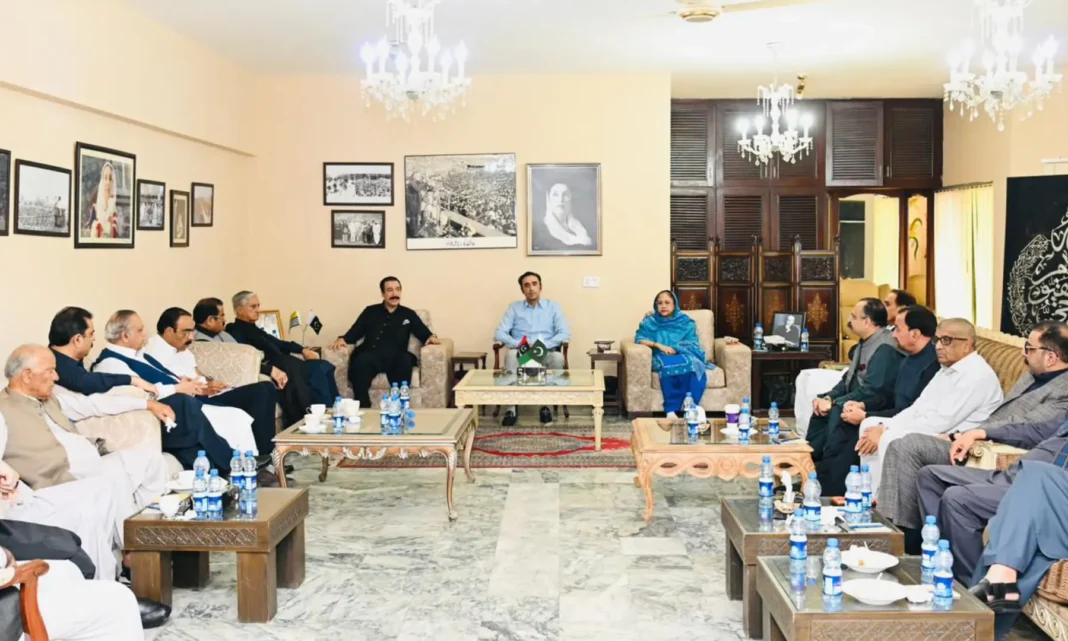
ISLAMABAD (MNN); Pakistan Peoples Party (PPP) Chairman Bilawal Bhutto Zardari on Sunday said he would meet Prime Minister Shehbaz Sharif to discuss the evolving situation in Azad Jammu and Kashmir (AJK), stressing that all issues should be resolved through dialogue and parliamentary processes.
Bilawal made the remarks while presiding over a meeting of the PPP’s parliamentary party from AJK in Islamabad. The session was attended by PPP leader Faryal Talpur and other party lawmakers, who reviewed the prevailing political situation in the region and exchanged views on possible solutions.
According to a statement issued by the PPP, Bilawal expressed concern over the growing tensions in AJK and reiterated the party’s commitment to addressing the concerns of the Kashmiri people.
“We have always prioritised the issues of Kashmiris. Political matters should be resolved through negotiations, democratic engagement and parliamentary forums,” Bilawal was quoted as saying.
He announced that he would soon hold consultations with Prime Minister Shehbaz Sharif to seek a political solution to the current crisis through dialogue and the legislative process.
The meeting took place amid heightened tensions in AJK following the government’s decision to declare the Joint Awami Action Committee (JAAC) a proscribed organisation and the group’s insistence on its demand to abolish 12 refugee seats in the AJK Legislative Assembly.
JAAC has also announced a protest for June 9, while general elections in AJK are scheduled for July 27.
Meanwhile, authorities intensified actions against the group, with AJK police sealing JAAC’s central office. A day earlier, security agencies arrested several JAAC leaders and activists in different parts of the region.
The AJK government on Friday officially declared JAAC a banned organisation, alleging that its activities were detrimental to public peace and state security.
At the centre of the dispute is JAAC’s demand to abolish the 12 legislative seats reserved for refugees from Indian-occupied Jammu and Kashmir who migrated to Pakistan after 1947.
The group argues that these seats have historically been used by mainstream political parties to influence government formation in Muzaffarabad, while the AJK Legislative Assembly recently reaffirmed support for maintaining the existing arrangement.
In response to the deteriorating situation, federal paramilitary forces have been deployed to assist local law enforcement agencies, and authorities have advised visitors to postpone travel to AJK until June 20 due to security concerns.
Separately, Minister for Parliamentary Affairs Tariq Fazal Chaudhry said the government had already fulfilled the overwhelming majority of JAAC’s demands agreed upon last year.
Addressing a press conference in Islamabad, he stated that 35 of the 38 demands included in the October 2025 agreement had been implemented.
He rejected claims that only three demands had been fulfilled, describing such assertions as misinformation and negative propaganda.
Chaudhry maintained that unresolved issues should be addressed through dialogue rather than protests or confrontational tactics.
He questioned whether the current unrest was aimed at weakening ties between Pakistan and AJK, creating divisions between Kashmiri refugees and local residents, or undermining the broader Kashmir cause.
The minister emphasised that the government had never refused to discuss any outstanding issues, including the status of the refugee seats, and had repeatedly invited JAAC representatives for consultations.
According to Chaudhry, a federal delegation met JAAC leaders in Muzaffarabad on May 30, where the demand to abolish the refugee seats was formally raised.
He said government representatives had proposed discussing the matter through an all-parties conference, the AJK Legislative Assembly or the AJK Supreme Court.
The minister also noted that approximately 2 to 2.2 million Kashmiri refugees reside in Pakistan and argued that the future of their representation could not be decided by a small group without broader political consensus.
He further highlighted several measures already implemented under the agreement, including the withdrawal of cases against JAAC protesters, reinstatement of government employees, improvements in internet services, procurement of electricity meters, infrastructure development projects and restoration of health card facilities.
Chaudhry said many development-related commitments required long-term implementation and could not be completed within a few months.
He urged all stakeholders to pursue peaceful dialogue, warning that repeated protest movements and political instability could adversely affect governance and public welfare in the region.