

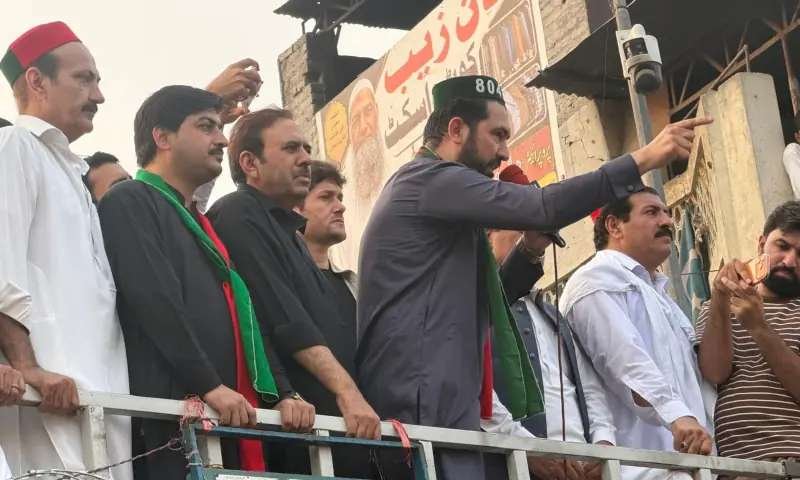
CHARSADDA/MARDAN (MNN); Khyber Pakhtunkhwa Chief Minister Sohail Afridi on Saturday rejected the possibility of imposing governor’s rule or an emergency in the province, warning that any such move would prompt the PTI’s ongoing long march to change its route and head towards Peshawar before moving to D-Chowk in Islamabad.
Addressing supporters in Mardan on the seventh day of the Pakistan Tehreek-e-Insaf (PTI) long march, Afridi said he would not accept any “illegal move” or decision imposed against the provincial government.
He urged the public to join the movement for the release of incarcerated PTI founder Imran Khan, asserting that Pakhtuns would not be intimidated by threats, guns or bullets.
Afridi said arrests and other measures would not weaken PTI workers, adding that the party would continue its struggle against what it described as injustices against Imran Khan.
Speaking at the gathering, PTI MNA Muhammad Atif Khan claimed that Afridi’s political strategy had placed the federal government in a difficult position.
The long march began on October 4 despite warnings from the federal government after talks between the Centre and the opposition collapsed on October 3, primarily over disagreements on counterterrorism policy.
Although the PTI initially announced that the march would proceed to Islamabad, its final route remains uncertain. The procession has so far remained within KP, where the party is in power.
Swabi preparations amid conflicting schedules
Meanwhile, authorities have transported containers to Swabi Interchange and the Indus River bridge on the M-1 Motorway to restrict the march’s movement. However, the motorway and the Grand Trunk Road remained open to traffic.
The bridge is strategically important because it connects Punjab and KP across the Indus River.
Afridi had earlier called on PTI supporters from across the country to reach Swabi Interchange on October 11. However, PTI district president Sohail Yousafzai said the main convoy would arrive on Monday, October 12, following directions to party workers, lawmakers and office-bearers to assemble there.
Yousafzai said convoys from Peshawar, Malakand and Kohat would reach Swabi on October 13, while those from Hazara, Bannu and Dera Ismail Khan would arrive the following day.
Afridi is expected to address party workers at Shewa Adda in Razaar tehsil, the district headquarters and Topi. According to KP Information Minister Shafi Jan, the convoy would stay overnight in Mardan, with the next phase of the march to be announced on October 13.
Afridi claims he refused to bow to pressure
Earlier, addressing a large gathering at Farooq-i-Azam Chowk in Charsadda, the KP chief minister reiterated his opposition to military operations in the province.
Afridi said he stood with the people and would not accept decisions imposed through pressure or threats.
“I was asked to sign, but I refused,” he said, claiming that attempts had been made to persuade him to approve certain decisions but that he had stood by his principles.
He said his positions on national security and Kashmir were clear and maintained that important national issues should be decided on principles rather than political pressure.
Referring to the possibility of governor’s rule or an emergency, Afridi said the situation had moved beyond a contest for political positions and power. He declared himself willing to sacrifice his office for Imran Khan and the people of KP.
The chief minister also highlighted the province’s sacrifices in the fight against terrorism, saying the concerns of residents regarding peace, stability and fundamental rights should not be ignored.
He urged PTI workers to remain united, disciplined and committed to their political struggle, reiterating that he would announce the next course of action at Swabi Interchange on October 13.
Hundreds of PTI supporters attended the Charsadda gathering, waving party colours and chanting slogans in support of Imran Khan. Afridi addressed the crowd from a container alongside party leaders.
KP police issue protest-management guidelines
As the PTI continued preparations for its long march, Khyber Pakhtunkhwa Inspector General of Police Zulfiqar Hameed issued operational guidelines directing police personnel to exercise restraint while dealing with public protests.
The guidelines, issued under the KP Police Act 2017 and existing operational procedures, warned that public gatherings could be exploited by disruptive elements to incite violence or carry out sabotage.
The police chief instructed officers to avoid using force against peaceful demonstrators and to engage protesters in negotiations through the senior-most police officer available.
However, the guidelines outlined a phased response in the event of violence, allowing the use of minimum necessary force under the law.
Police could issue warnings and use tear gas, rubber bullets and paper-ball guns from a safe distance to disperse violent protesters. If necessary, baton charges and specially trained unarmed squads could be deployed to apprehend individuals involved in violence.
In cases of extreme violence posing an imminent threat to life or property, the guidelines allowed aerial firing by specially authorised armed personnel, but only under the direction of the senior-most officer present.
The instructions stressed extreme caution to prevent casualties and damage to property. Police station house officers were also directed to arrange video recording of entire protests and processions, preferably through professional cameramen.
Police were instructed to seize illegal firearms and other prohibited articles and initiate legal proceedings against those possessing them. District police officers, sub-divisional police officers and station house officers were directed to personally supervise protests in their jurisdictions.
The guidelines also authorised police to regulate or temporarily close streets and public places for security reasons, stop processions violating permit conditions and deploy adequate personnel at vulnerable locations, including police stations, government buildings, petrol stations, banks, shopping centres and major roads.
The prescribed deployment included fully equipped anti-riot squads, unarmed teams to identify and apprehend violent individuals, plainclothes personnel to identify potential troublemakers and armed personnel at designated locations in emergencies under the direct command of district police officers.
Following the issuance of the guidelines, KP Information Minister Shafi Jan alleged that provincial police had withdrawn security assigned to him and other lawmakers.
He warned that the provincial police chief would be responsible if any harm came to him or a parliamentarian.