


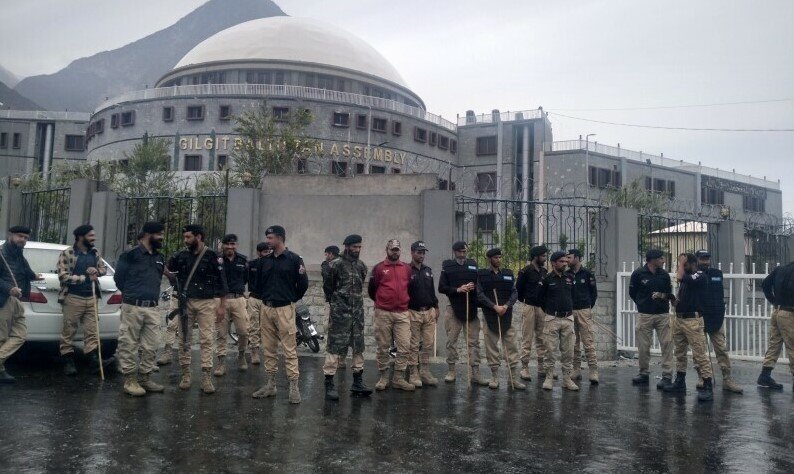
ISLAMABAD (MNN); Pakistan Tehreek-e-Insaf (PTI) on Saturday accused the federal government and the Gilgit-Baltistan administration of orchestrating “pre-poll rigging” ahead of the region’s general elections, citing the deployment of thousands of security personnel from outside the territory and alleging widespread suppression of the party’s political activities.
The elections in Gilgit-Baltistan are scheduled to take place on Sunday after being delayed by four months due to severe winter conditions. In the run-up to the polls, major political parties, including the PPP and PML-N, have intensified election campaigns across the region.
Addressing a press conference, PTI Information Secretary Sheikh Waqas Akram claimed that the deployment of more than 13,000 security personnel from outside Gilgit-Baltistan, in addition to the region’s 5,600 local police personnel, was excessive and politically motivated.
According to Akram, the additional force includes approximately 11,000 personnel from Punjab Police, 1,000 from Sindh Police, 700 from the Frontier Constabulary and 140 from Islamabad Police.
He alleged that the large-scale deployment was intended to influence polling activities and create an atmosphere of fear among voters rather than ensure security.
The PTI leader further claimed that internet services and landline communications had been disrupted in parts of Gilgit-Baltistan, describing the move as an attempt to hinder communication among party workers and supporters.
Akram alleged that several PTI workers had been detained during the past two days despite what he described as growing public support for the party’s candidates.
He also accused authorities of pressuring elected representatives to leave the party, restricting PTI’s political activities and creating obstacles for candidates associated with party founder Imran Khan.
According to PTI, efforts to form a last-minute electoral alliance with the Gilgit-Baltistan Democratic Party were undermined after the party’s election symbol was allegedly withdrawn without formal notification.
The party further alleged manipulation of polling schemes, restrictions on postal ballots for PTI supporters and unequal treatment of political parties during the election campaign.
Akram claimed that PTI leaders and workers had been prevented from holding rallies and conducting election activities, while repeated requests for legal justification of these restrictions allegedly went unanswered.
He also accused government officials of influencing voters in favour of rival political parties and claimed that administrative machinery was being used to shape the election outcome.
The PTI information secretary alleged that party representatives had been warned that PTI would not be allowed to win seats in the region and that candidates could face disqualification if they challenged the process.
Describing the situation as a threat to democratic norms, Akram urged the international community, human rights organisations and democratic institutions to take notice of what he termed violations of political and electoral rights in Gilgit-Baltistan.
Separately, PTI expressed concern over the Azad Jammu and Kashmir government’s decision to declare the Joint Awami Action Committee (JAAC) a proscribed organisation.
In a statement, the party said political, social and constitutional grievances should be addressed through dialogue, democratic engagement and constitutional mechanisms rather than bans or coercive measures.
PTI questioned the government’s decision, arguing that authorities had previously engaged in negotiations with JAAC, signed agreements and held meetings with its leadership.
The party maintained that suppressing peaceful political activity, restricting communication and limiting public protests were ineffective approaches that could undermine democratic processes.