


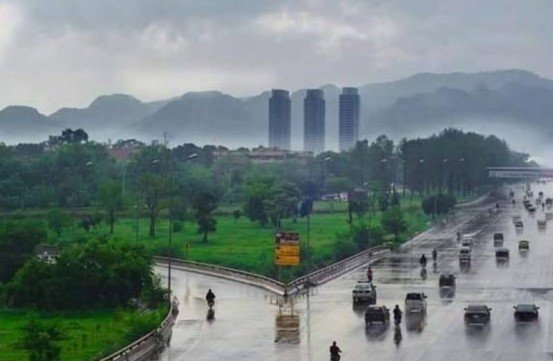
ISLAMABAD (MNN); The Pakistan Meteorological Department (PMD) on Wednesday issued a fresh weather advisory, forecasting widespread rain, wind and thunderstorms across the upper parts of the country, including Islamabad and the Potohar region, during the coming days.
According to the advisory issued at 3pm, monsoon currents are currently penetrating the upper regions of Pakistan, while a westerly weather system is also affecting these areas. The westerly wave is expected to strengthen between September 4 and 5, increasing the likelihood of heavy rainfall in several regions.
The PMD said rain-wind and thundershowers, with isolated heavy falls, are expected in several areas of Azad Kashmir from Thursday to Sunday, with occasional gaps.
The affected areas include Neelum Valley, Muzaffarabad, Rawalakot, Poonch, Hattian, Bagh, Haveli, Sudhanoti, Kotli, Bhimber and Mirpur.
Similar weather conditions are expected in Gilgit-Baltistan, including Diamer, Astore, Ghizer, Skardu, Hunza, Gilgit, Ghanche and Shigar during the same period.
In Khyber Pakhtunkhwa, widespread rain-wind and thunderstorms, accompanied by scattered heavy and at times very heavy rainfall, have been forecast from the evening of September 3 until September 5.
The affected districts include Peshawar, Dir, Chitral, Swat, Kohistan, Malakand, Mardan, Nowshera, Charsadda, Swabi, Shangla, Battagram, Buner, Kohat, Hangu, Kurram, Bajaur, Mohmand, Khyber, Orakzai, Mansehra, Abbottabad, Haripur, Karak, Tank, Lakki Marwat, Dera Ismail Khan, Bannu and Waziristan.
For Islamabad and upper Punjab, the Met Office has forecast rain-wind and thundershowers, with isolated heavy and very heavy rainfall, from September 3 to 5.
Areas likely to receive heavy rainfall include Islamabad, Rawalpindi, Murree, Galliyat, Jhelum, Chakwal, Talagang, Attock, Lahore, Sialkot, Sheikhupura, Narowal, Mandi Bahauddin, Gujrat, Gujranwala, Wazirabad, Hafizabad and Kasur.
The PMD has also predicted rain and thunderstorms in Okara, Nankana Sahib, Sargodha, Khushab, Mianwali, Noorpur Thal, Faisalabad, Jhang, Toba Tek Singh, Layyah, Bhakkar, Sahiwal, Dera Ghazi Khan and adjoining areas between September 4 and 5.
Meanwhile, mainly hot and humid weather is expected to continue in most parts of Sindh and Balochistan. However, rain, wind and thunderstorms are likely in Zhob, Barkhan, Musakhel and surrounding areas.
The PMD has warned that heavy rainfall could cause urban flooding in low-lying areas of Islamabad and Rawalpindi, as well as Peshawar, Mardan, Swabi, Gujranwala, Gujrat, Sialkot, Faisalabad and Lahore, particularly on Friday and Saturday.
The weather advisory also warned of possible flash flooding in local streams and nullahs in Dir, Chitral, Swat, Kohistan, Shangla, Battagram, Buner, Malakand, Mansehra, Abbottabad, Gilgit-Baltistan, Kashmir, Murree, Galliyat and the twin cities during the forecast period.
The Met Office further cautioned that landslides could occur in the hilly areas of Khyber Pakhtunkhwa, Gilgit-Baltistan, Murree, Galliyat and Kashmir.
Tourists and travellers have been advised to remain cautious and avoid unnecessary travel to vulnerable areas during periods of heavy rainfall.
Farmers have also been advised to plan and manage crop-related activities according to the expected weather conditions.
The PMD urged all relevant authorities and emergency response agencies to remain alert and take precautionary measures to prevent any untoward situation.
The latest warning comes after heavy rainfall continued to affect Rawalpindi and Islamabad earlier this week.
On Tuesday morning, heavy showers inundated several low-lying areas of the twin cities and caused the water level in Leh Nullah to rise.
Earlier, heavy rain lasting around two hours on Monday resulted in significant water accumulation on roads and in low-lying areas of Rawalpindi, with several roads resembling ponds and a number of cars and motorcycles stranded in rainwater.
Authorities and residents have been urged to remain vigilant as another spell of potentially heavy and, in some areas, very heavy rainfall is expected to affect large parts of northern and upper Pakistan.