


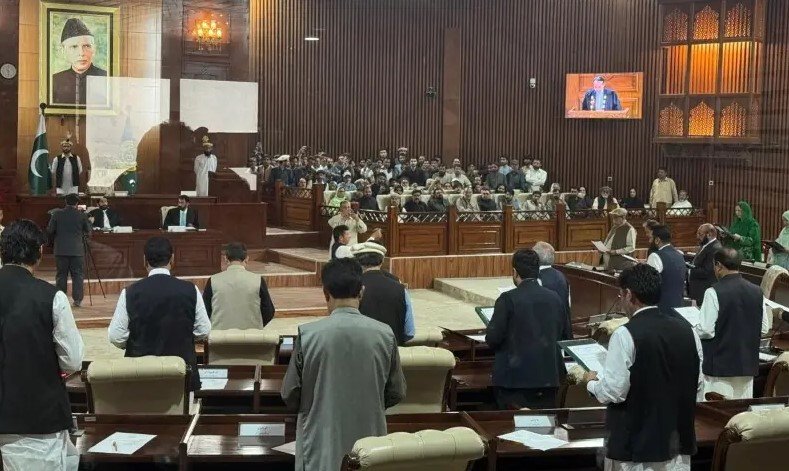
GILGIT (MNN); The newly constituted Gilgit-Baltistan Assembly on Monday elected Pakistan Peoples Party (PPP) leader Advocate Amjad Hussain as chief minister unopposed, completing the formation of the regional government only hours after newly elected lawmakers took oath.
The development came during the first session of the sixth Gilgit-Baltistan Assembly, which also witnessed the unopposed election of PPP’s Imran Nadeem Shigri as speaker and Pakistan Muslim League-Nawaz (PML-N) leader Malik Kifayatur Rehman as deputy speaker.
Following his election as speaker, Nadeem announced the schedule for the election of the leader of the House and invited nominations for the chief minister’s office. Lawmakers were given time until 7:40pm to submit or withdraw nomination papers.
Advocate Amjad Hussain, the PPP’s nominee for chief minister, filed his nomination papers, while no other candidate entered the race. As a result, Speaker Imran Nadeem formally announced at 8pm that Hussain had been elected unopposed as the new chief minister of Gilgit-Baltistan.
The speaker also declared PML-N Gilgit-Baltistan President Hafeezur Rehman as the leader of the opposition after opposition members submitted a formal requisition in support of his nomination.
The assembly proceedings attracted significant public and political interest. The assembly hall remained packed with lawmakers, political workers, journalists, supporters, visitors, and invited guests. Press galleries and public seating areas were filled with enthusiastic supporters who frequently chanted slogans in favour of their respective leaders.
Several senior political figures attended the proceedings from the VIP galleries, including PPP Central Secretary General Syed Nayyar Hussain Bukhari, Information Secretary Qamar Zaman Kaira, Gilgit-Baltistan Governor Syed Mehdi Shah, and other prominent political leaders.
Earlier in the day, the sixth Gilgit-Baltistan Assembly formally began its tenure as 30 members took oath during the inaugural session held in Gilgit.
The members sworn in included 21 lawmakers elected on general seats in the June 7 elections, six women members elected on reserved seats, and three technocrats. Results for three remaining constituencies are yet to be finalized due to ongoing legal and electoral proceedings.
Outgoing Speaker Nazir Ahmed administered the oath to the newly elected members at 10am. After the swearing-in ceremony, he adjourned the session until the afternoon to facilitate elections for the assembly’s key constitutional offices.
When the session resumed, Nazir Ahmed announced the schedule for the election of speaker and deputy speaker and allowed members to submit nomination papers until 5:15pm.
To expedite the formation of the government, the outgoing speaker sought and obtained approval from the house to suspend relevant procedural rules, allowing elections for speaker, deputy speaker, and chief minister to be held on the same day.
PPP’s Imran Nadeem Shigri, elected from Shigar, and PML-N’s Malik Kifayatur Rehman, elected from Diamer, submitted nomination papers for speaker and deputy speaker respectively. As no other candidates filed nominations, both leaders were elected unopposed.
Following his election, Nazir Ahmed administered the oath of office to Imran Nadeem, who thanked his party leadership and fellow lawmakers for their confidence and unanimous support.
Speaker Nadeem then formally declared Malik Kifayatur Rehman elected unopposed as deputy speaker and administered the oath to him as well.
Imran Nadeem represents constituency GBA-12 Shigar and is regarded as an experienced political figure in Gilgit-Baltistan. He was previously elected to the assembly in 2004 on a Pakistan Muslim League-Quaid (PML-Q) ticket and has remained actively involved in regional politics and public service over the years.
Deputy Speaker Malik Kifayatur Rehman secured his seat from GBA-15 Diamer-I (Tangir), where he defeated former chief minister Haji Gulbar Khan in the recent elections, a result widely viewed as a significant political victory.
The assembly session had originally been summoned for 9am on Monday to administer oaths to newly elected representatives and elect the speaker and deputy speaker.
The government formation process follows the June 7 Gilgit-Baltistan elections, which produced a fragmented but manageable political landscape. The PPP emerged as the single largest party by securing 13 seats in the assembly. The PML-N won nine seats, while the Istehkam-i-Pakistan Party (IPP) secured six seats. Majlis Wahdat-i-Muslimeen (MWM) and a Pakistan Tehreek-e-Insaf-backed independent candidate won one seat each.
Following the election results, negotiations among major political parties led to the formation of a broad political understanding. The PML-N and IPP agreed to support PPP candidates for the positions of chief minister, speaker, and deputy speaker, paving the way for unanimous elections.
Although the PPP had earlier announced its intention to form a coalition government with the support of the PML-N, both parties later agreed on a unique arrangement under which the PML-N would support the government while occupying opposition benches in the assembly.
Political observers believe the consensus-based election of the chief minister, speaker, and deputy speaker reflects an effort by major parties to ensure political stability and smooth governance in Gilgit-Baltistan at a time when the region faces significant development, infrastructure, and administrative challenges.
With the assembly now fully functional and key constitutional offices filled, the new government is expected to focus on governance reforms, economic development, public service delivery, and addressing regional concerns in the coming months.