


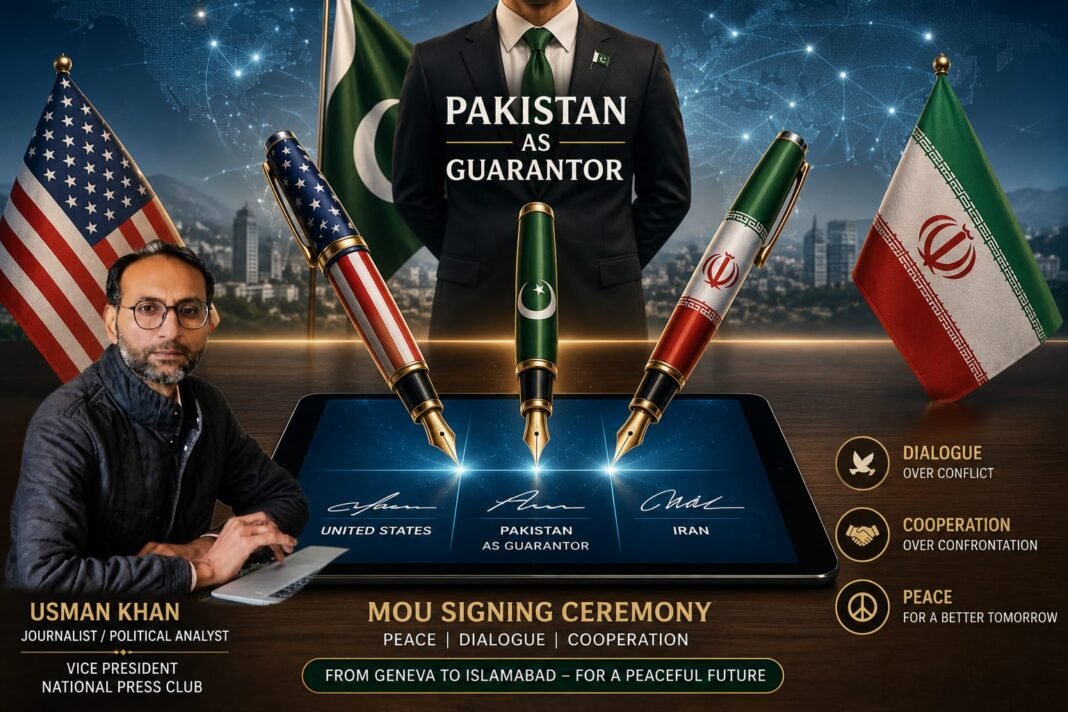
In international politics, there are moments that appear historic on the surface, yet a closer examination reveals that the real decisions are still waiting to be made. The anticipated electronic signing ceremony of the Memorandum of Understanding (MoU) between the United States and Iran in Geneva seems to be one such moment.
What makes this development particularly unusual is that the beginning of the end of tensions between two major global powers is not taking place through a traditional peace conference or a high-profile summit. Instead, it is expected to unfold through an electronic ceremony, with the parties signing the document remotely from their respective locations via video link. Diplomatic history offers few examples of such arrangements, making this event both extraordinary and, to some extent, ceremonial in nature.
Interestingly, reports regarding the Geneva MoU are not confined to unofficial sources. Signals of this breakthrough have emerged from Washington, Tehran, and Islamabad alike. Pakistan’s Prime Minister has also hinted at an important development expected in Geneva. Yet, despite these encouraging indications, several fundamental questions remain unanswered.
If all major issues have indeed been settled, why is there still a need for technical committees?
According to available information, these committees continue to deliberate on matters where complete consensus has yet to be achieved. Such issues may include security concerns, future implementation mechanisms, monitoring procedures, compliance frameworks, and mutual guarantees. Their recommendations are expected to shape the next phase of the peace process.
For this reason, the Geneva MoU may be viewed not as a final peace agreement but rather as an extension of the existing temporary ceasefire arrangement. While it undoubtedly represents progress, it appears more likely to be a transitional step than the ultimate destination.
The symbolic significance of the Geneva ceremony should not overshadow its practical limitations. Peace agreements are not measured by signatures alone but by the difficult work that follows them. The true challenge lies in translating diplomatic commitments into realities on the ground.
In my view, Pakistan’s role in this process could prove to be one of its most significant diplomatic achievements in recent years. If the technical committees succeed in bridging the remaining gaps, it is not beyond imagination that the final round of negotiations could take place in Islamabad. In such a scenario, a permanent ceasefire or comprehensive peace agreement could enter history under the title of the “Islamabad Declaration.”
Such an outcome would not only enhance Pakistan’s diplomatic standing but would also reaffirm its constructive and balanced role in regional affairs. It would reflect Islamabad’s ability to facilitate dialogue at a time when polarization and confrontation dominate international relations.
The timeline of this process also deserves careful consideration. Although some observers anticipate major progress within the next twenty-four hours, a more realistic assessment suggests that resolving the remaining technical issues will require time. In my personal opinion, the process could take another one to two months, with the possibility of a comprehensive and lasting agreement emerging by August.
At the same time, domestic political considerations in the United States cannot be ignored. President Donald Trump faces an election in November, and American political history has repeatedly demonstrated that major foreign policy achievements often become valuable assets during election campaigns. It is therefore conceivable that the pace of negotiations could be managed in a manner that allows a significant diplomatic success to be presented before the world as the election season approaches.
This possibility does not diminish the importance of the peace effort. Rather, it highlights the complex reality that diplomacy and domestic politics frequently intersect. International agreements are often shaped not only by strategic calculations abroad but also by political imperatives at home.
However, all of this remains within the realm of analysis and political interpretation. The ultimate reality will be determined at the negotiating table. In the pursuit of peace, implementation matters far more than announcements. No matter how historic the Geneva ceremony may ultimately be portrayed, the true test will lie in transforming commitments on paper into sustainable peace.
Today, the world stands at a crossroads where the exhaustion of war and the necessity of peace have both reached their limits. If the Geneva MoU genuinely becomes the first step toward an Islamabad Declaration, it will represent far more than an agreement between two states. It will serve as a reminder that dialogue across the negotiating table ultimately holds greater power than battles fought on the battlefield.
Only time will tell whether Geneva’s ceremonial signing becomes a brief chapter in history or the foundation of a lasting peace the world has long awaited.