


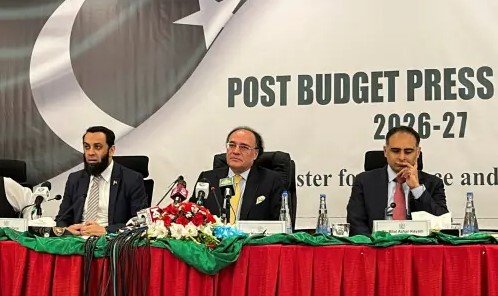
ISLAMABAD (MNN); Finance Minister Muhammad Aurangzeb on Saturday described the proposed federal budget for FY2026-27 as a major step towards sustainable economic growth, saying the government had laid the foundation for an export-led economy through tax relief, business incentives and structural reforms.
Addressing a post-budget press conference in Islamabad, Aurangzeb said the government had made substantial progress towards its goal of economic expansion and competitiveness.
“We have made significant progress in the direction of economic growth that we outlined earlier,” he said.
The finance minister emphasized that the government had worked extensively to create an enabling environment for export-led growth. He highlighted the abolition of advance tax for exporters and proposed reductions in the super tax as key measures to support businesses and improve competitiveness.
Under the proposed budget, super tax has been abolished for businesses earning between Rs150 million and Rs500 million annually, while the rate for companies earning above Rs500 million has been reduced from 10 percent to 8 percent.
Aurangzeb said Prime Minister Shehbaz Sharif had directed the government to eliminate the super tax for exporters and provide additional incentives to boost exports.
He also announced an additional subsidy of Rs70 billion for the Export Finance Scheme (EFS), aimed at significantly enhancing financing facilities for exporters.
The finance minister stressed that macroeconomic stability remained essential for attracting investment.
“If foreign exchange reserves remain strong, interest rates stable, and policies consistent, local investors will come first, followed by foreign investors,” he said.
Commenting on the three-year freeze on provincial development transfers, Aurangzeb praised provincial governments for supporting the federal government in addressing pressing national priorities, including enhanced security requirements reflected in the defence budget.
He said the arrangement was expected to remain in place over the next three years.
Responding to concerns about development spending, Aurangzeb said Pakistan did not face a shortage of resources, noting that Rs4.3 trillion had been allocated for development and uplift projects nationwide.
He stressed the importance of expanding public-private partnerships to encourage greater private-sector participation in economic activity.
On reports regarding a possible merger between the Board of Investment (BoI) and the Special Investment Facilitation Council (SIFC), the minister said the move was part of the government’s rightsizing initiative aimed at reducing duplication and improving efficiency.
He added that Prime Minister Shehbaz Sharif had already approved the merger in principle, although the implementation mechanism was still being finalised.
Defending the proposed 7 percent increase in salaries and pensions for government employees, Aurangzeb said the decision was based on inflation trends and complemented broader tax relief measures announced in the budget.
The finance minister also outlined plans to modernise tax collection through automation, digital monitoring and artificial intelligence, saying the government wanted to reduce human intervention and improve transparency.
A new taxation model, currently under development, would focus on broadening and deepening the tax base while improving compliance, he said.
Aurangzeb clarified that there was no proposal to increase the petroleum levy, although adjustments between petrol and diesel levies may continue as part of routine policy management.
Regarding rising global oil prices due to tensions in the Middle East, he acknowledged that the impact would extend into the next fiscal year but said the government had built sufficient fiscal safeguards into its budget projections.
The finance minister also highlighted concerns over Pakistan’s rapidly growing population, describing it as an “existential challenge”.
He noted that taxes on contraceptives and sanitary products had been removed to improve access and suggested that population factors should be reviewed in future National Finance Commission (NFC) awards.
Speaking on trade and industrial policy, Aurangzeb said the government was continuing its five-year tariff reform programme aimed at lowering the cost of raw materials and intermediate goods for industry.
He stressed the need to reduce the trade deficit and promote exports, particularly in the information technology sector.
According to the minister, IT exports are expected to reach $4.5 billion next year. To support the sector, the government has maintained the 0.25 percent Final Tax Regime (FTR) for IT companies and freelancers following consultations with industry stakeholders.
Aurangzeb said the budget also provided relief to lower and middle-income salaried individuals by reducing tax rates in key income slabs.
Meanwhile, FBR Chairman Rashid Mahmood Langrial described the proposed budget as entirely focused on export-led growth.
He argued that reducing poverty required increasing exports, as domestic demand alone was insufficient to sustain long-term economic expansion.
Langrial said social protection programmes such as the Benazir Income Support Programme would continue supporting vulnerable segments of society that remain outside formal economic activity.
Aurangzeb also highlighted growth in agricultural financing, which increased by 15 percent year-on-year and exceeded Rs2 trillion overall.
He said the Zarkhez-e Scheme was providing collateral-free financing to small farmers, while Rs125 billion of the Rs262 billion allocated under the Prime Minister’s Youth Business and Agriculture Loan Scheme had been earmarked for agriculture.
The minister further announced the elimination of customs and regulatory duties on key agricultural equipment, including tractors, combine harvesters and centrifugal pumps, to encourage value addition and productivity.
Discussing the housing sector, Aurangzeb said construction remained a vital component of economic growth and business activity.
Information Minister Attaullah Tarar said the government’s reform agenda had created the fiscal space needed to provide relief and described ongoing reforms in the Federal Board of Revenue as unprecedented.
He said efforts to improve transparency and reduce leakages, particularly in the sugar sector, were yielding positive results.
Minister of State for Finance Bilal Azhar Kiani described the proposed financial plan as a budget for salaried workers, exporters, industrialists, the construction industry and low-income families seeking home ownership.
He said tax relief had been specifically targeted towards lower-income groups, while exporters’ key demands — including the removal of advance tax and reduction in super tax rates — had been addressed.
The FY2026-27 budget also proposes taxes on social media earnings, a fixed tax regime for small traders and shopkeepers, incentives for electric vehicles and motorcycles, and additional measures aimed at reviving economic activity and boosting exports.